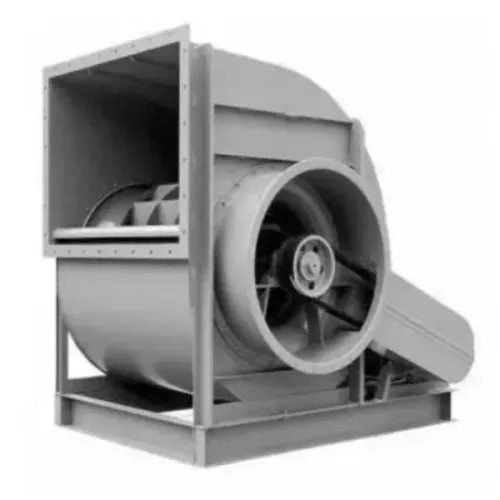
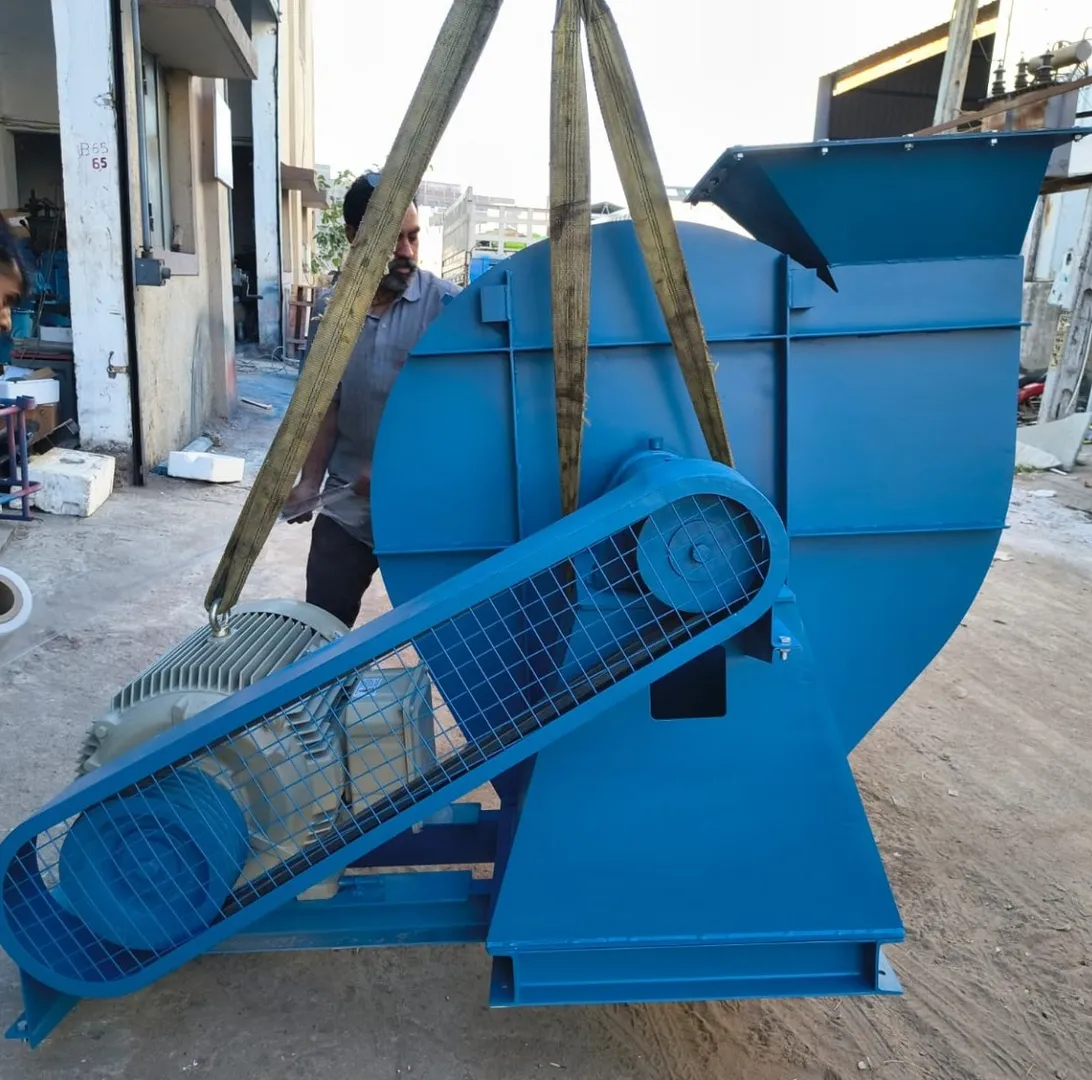
Ventilation Centrifugal Blower
A Ventilation Centrifugal Blower is a dynamic air-moving machine designed to handle a specified volumetric flow rate against a defined system resistance.
In a centrifugal blower, air enters the impeller axially and is accelerated radially by the rotating impeller. The velocity energy generated by the impeller is subsequently converted into static pressure within the volute/casing or discharge system.
Hare Krishna Blower designs and manufactures centrifugal blowers for industrial ventilation, exhaust, process-air handling, fume extraction, dust extraction and HVAC applications.
The blower is selected according to the complete system duty rather than motor power alone.
The operating sequence of a centrifugal blower is:
Air Inlet → Impeller → Velocity Generation → Pressure Conversion → Casing/Volute → Discharge
The rotating impeller transfers mechanical energy from the motor to the air.
The developed pressure is generally represented as:
Total Pressure = Static Pressure + Velocity Pressure
For system selection, it is important to clearly define whether the specified pressure is:
- Static Pressure
- Total Pressure
- Pressure rise across the fan
- System resistance
Confusing static and total pressure can result in incorrect blower selection.
Q1. What is a Ventilation Centrifugal Blower?
A Ventilation Centrifugal Blower is an industrial air-moving equipment designed to efficiently move large volumes of air through ducts, ventilation systems, exhaust systems, and industrial processes.
Hare Krishna Blower manufactures robust centrifugal blowers designed for reliable and continuous industrial operation.
Q2. Where are Ventilation Centrifugal Blowers used?
Ventilation centrifugal blowers are commonly used for:
• Industrial ventilation
• Factory exhaust systems
• Heat and fume extraction
• Dust and air extraction
• Fresh-air supply systems
• HVAC systems
• Process ventilation
• Boiler and furnace ventilation
• Kitchen and commercial exhaust
• Textile and printing industries
• Foundry and metal industries
• Cement and mineral industries
• Pharmaceutical industries
• Food processing industries
• Paper and pulp industries
Q3. What is the difference between a Centrifugal Fan and a Centrifugal Blower?
Both equipment use centrifugal action to move air, but the selection depends on the required airflow and pressure.
A centrifugal fan is generally selected for ventilation and air circulation applications, while a centrifugal blower is commonly used where higher pressure development or resistance through ducts, filters, scrubbers, cyclones, or process equipment is involved.
The actual selection should always be based on the required airflow, pressure, temperature, density, and system resistance.
Q4. How do I select the correct Ventilation Blower?
The blower should be selected based on the following parameters:
• Required Airflow – CFM / CMH
• Static Pressure – mmWG / Pa / in. WG
• Total Pressure, if applicable
• Air Temperature
• Air Density
• Gas composition
• Operating altitude
• Required RPM
• Motor Power
• Duty cycle
• Installation arrangement
• Material of construction
Providing accurate operating conditions helps ensure proper blower selection and performance.
Q5. What airflow capacities can Hare Krishna Blower provide?
Hare Krishna Blower can design and manufacture centrifugal blowers according to the customer's required air volume and pressure.
Instead of selecting a blower only by motor HP, we recommend selecting the complete system based on the required duty point.
Example:
Airflow: 10,000 CMH
Static Pressure: 300 mmWG
Temperature: 40°C
The blower can then be engineered according to the required operating point.
Keywords